Beyond Medals: Social Media Activist Urges KONI to Address Sports, Health and Social Recovery
ACEH TAMIANG — The recent floods have once again tested the resilience of communities across Aceh Tamiang. Behind the floodwaters, damaged homes and the struggle of residents to protect their families lies another challenge that is often less visible: how to restore the community’s spirit after a disaster, particularly for children who have experienced fear and anxiety, as well as parents who must rebuild their lives under difficult circumstances.
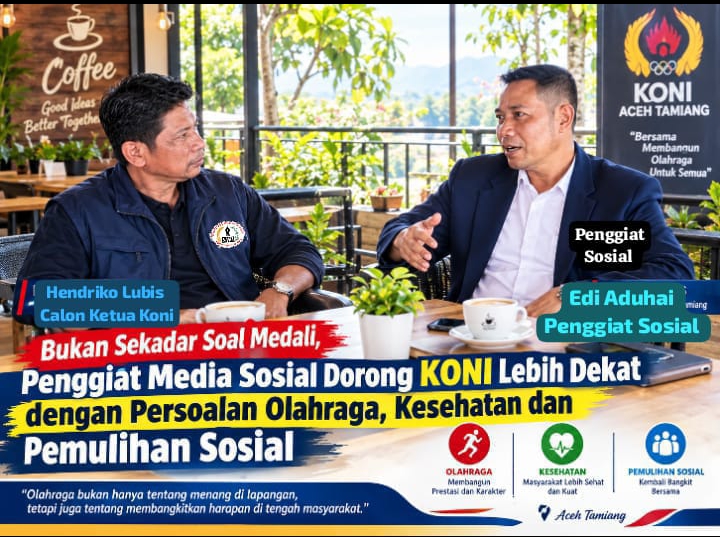
This issue was discussed at a café in Karang Baru, Aceh Tamiang, on Tuesday (September 22, 2026), amid growing public attention to the race for the chairmanship of the Indonesian National Sports Committee (KONI) in Aceh Tamiang.
Social media activist Edi Aduhai said the future leadership of KONI should not focus solely on medals, competitions and sporting achievements. In his view, the organization should also develop greater sensitivity toward the broader social conditions facing the community.
“We should not only think about who will become chairman. We should also think about what can be done after our community has experienced a disaster. Children need spaces where they can smile again, parents need encouragement to recover, and sport can become one of the ways to rebuild people’s confidence,” Edi said.
According to Edi, the emergence of a journalist as a potential KONI leader, such as Hendriko Lubis, has attracted attention because journalism is closely connected with various community issues. Journalists are accustomed to listening to public concerns, examining problems from different perspectives and conveying information to the wider community.
Edi believes that such experience could become a communication asset if it is translated into transparent sports governance and concrete programs. However, he stressed that the expectation of change should ultimately be measured through programs and performance, rather than through a person’s background alone.
Hendriko Lubis has emerged in public discussions as one of the figures expressing an intention to participate in the process of selecting the next KONI Aceh Tamiang chairman. He is known as Chairman of the Aceh Tamiang branch of the Indonesian Journalists’ Joint Secretariat (SWI) and also serves as Chairman of PERKEMI Aceh Tamiang.
From the Flood Zone to the Sports Field
For Edi, Aceh Tamiang’s challenges do not end when the floodwaters recede. The recovery process continues, with communities facing the task of restoring homes, livelihoods and a sense of security.
He therefore views sport as potentially contributing to social recovery, particularly for children and young people.
“Children who have seen their homes submerged, lost their belongings or experienced fear need more than material assistance. They also need places to play, exercise, gather and gradually experience a sense of normality again. Parents also need to see their children smiling again. That is where sport has a social value beyond competition,” he said.
This perspective places KONI within a broader community context. KONI’s primary responsibility remains the development of achievement-oriented sports. Health services and trauma recovery are not solely the responsibility of a sports organization and require cooperation with the relevant government agencies and professionals.
Nevertheless, community sports activities, youth development and sports-based social programs could potentially contribute to a wider recovery ecosystem when properly coordinated with the appropriate institutions.
A Leadership Change or a Change in the System?
The discussion surrounding Hendriko also raises a broader question: Will a change in leadership be followed by meaningful changes in the system?
Aceh Tamiang’s sports community needs more than a leader who can communicate publicly. Athletes need consistent development programs, coaches need support, sports federations need clear planning, and young people need opportunities to develop their abilities.
For that reason, expectations surrounding any prospective chairman should ultimately be tested through concrete programs, organizational governance and measurable work—not simply popularity or social media support.
The selection process for the KONI chairman should also continue according to the organization’s established mechanisms and provide fair opportunities for all parties involved.
Amid the community’s recovery from flooding, sport can potentially serve as a space for rebuilding social connections. Sports fields can become places where children return to playing. Sports communities can strengthen solidarity. Youth development programs can help restore confidence and optimism among the younger generation.
Ultimately, the KONI leadership issue is not merely about who occupies the chairman’s seat. The larger question is whether the next leadership can develop a more transparent system, sustainable programs and a sporting environment that is closer to the people.
The floods may leave behind mud, damage and emotional scars. But they also create a powerful reminder of the need to rebuild. For social media activists, the current KONI leadership race should therefore become a forum for testing ideas: Will sport focus solely on achievements on the podium, or can it also contribute to restoring hope among the people—from children to parents?
In the end, the answer will not be determined by powerful slogans, but by programs, accountable governance, transparency and real work once a leader receives the mandate to serve and advance Aceh Tamiang.
(SIPS)