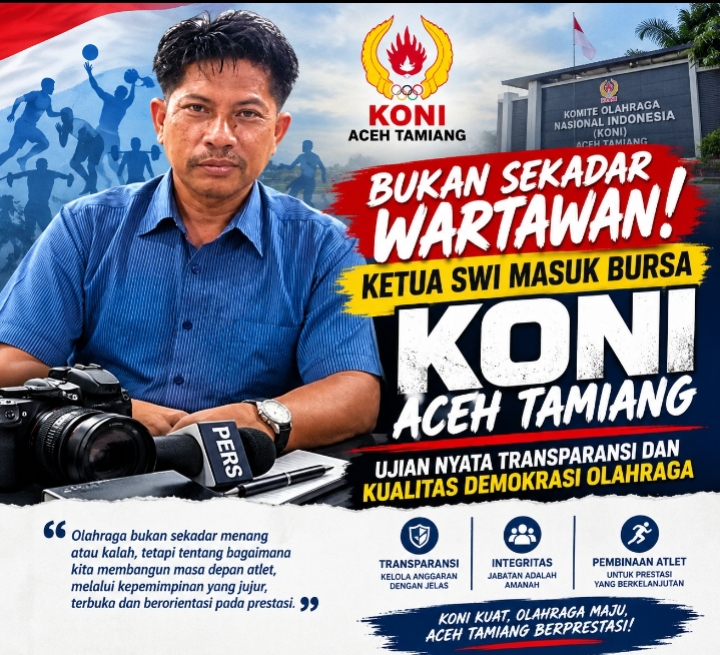
ACEH TAMIANG, INDONESIA — The race for the chairmanship of the Indonesian National Sports Committee (KONI) in Aceh Tamiang Regency is about more than securing a leadership position. It represents an important test of whether the region’s sports organization will genuinely prioritize athlete development, professional management, transparency, and sporting achievements.
Hendriko Lubis, Chairman of the Indonesian Journalists Association Secretariat (SWI) in Aceh Tamiang, as a prospective candidate for KONI chairman brings a new perspective to the leadership debate. His involvement raises an important question: Can experience in journalism, particularly its role in promoting transparency, public accountability, and social oversight, be translated into effective leadership in the sports sector?
This statement is stated at Karang Baru on Tuesday (13/10/2026).
In journalism, a position of authority should never be an excuse to silence criticism. Instead, criticism serves as a means of ensuring that power is exercised responsibly. The same principle should apply to sports organizations. Whoever leads KONI must be prepared to welcome evaluation, maintain open communication, and ensure that programs and budgets are managed transparently in accordance with applicable regulations. KONI is not the private domain of a select few; it is an institution whose responsibilities extend to athletes, coaches, sports associations, and the future of regional sports development.
The fundamental question is not who commands the strongest support, but who is genuinely prepared to work for the advancement of sports. Personal relationships, organizational networks, and political connections may form part of the dynamics surrounding an election. However, they should never replace more substantial considerations, including managerial capacity, professional track record, integrity, understanding of athlete development, and the ability to establish measurable and sustainable programs.
Hendriko Lubis’s involvement as an SWI chairman must not be reduced to a symbolic candidacy or a headline-grabbing development. His journalistic experience will have meaningful value only if it translates into a genuine commitment to transparency, constructive communication, and evidence-based evaluation. At the same time, holding a leadership position in a press organization does not automatically guarantee the ability to manage a sports institution. The capacity to coordinate sports associations, secure resources, strengthen athlete development, and improve sporting performance must still be demonstrated through concrete plans and measurable results.
Sports stakeholders in Aceh Tamiang should therefore ask every candidate some challenging questions: What will be done for athletes who train with limited facilities? How will sports associations receive consistent support? What strategies will be implemented to improve performance, strengthen competition, and ensure that budgets are allocated according to clear priorities? These are the questions that should dominate the leadership race—not merely calculations of political support or behind-the-scenes negotiations over influence.
Ultimately, the KONI chairmanship is not a prize for those who are most successful at gathering supporters; it is a responsibility that must be justified through hard work, integrity, and sporting achievements. Hendriko Lubis and every other candidate should be assessed using the same fair, transparent, and objective standards. The sporting community does not need a spectacle of competing ambitions. It needs leadership capable of providing certainty in athlete development, respecting the dedication of coaches and athletes, and building a clear, sustainable future for sports in Aceh Tamiang.
Because when the pursuit of a leadership position takes precedence over the interests of athletes, what is at stake is not merely a candidate’s reputation, but the future of sports throughout the region.
(SIPS)